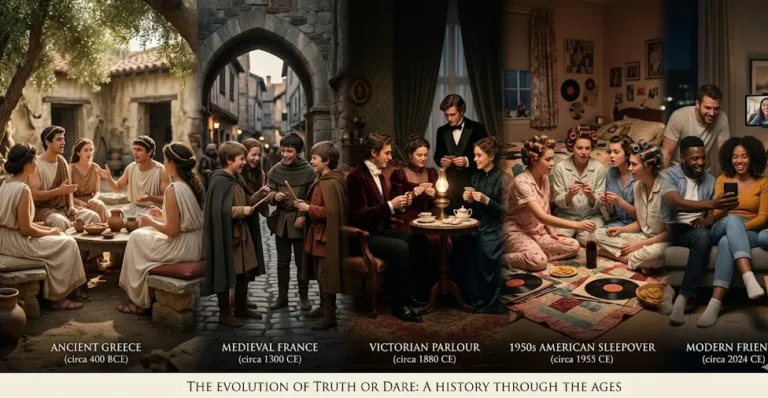
You pulled up a generic Truth or Dare list for your friend’s birthday. Twenty minutes in, someone is answering a question about their “most embarrassing childhood memory” that has nothing to do with anyone in the room. The energy drops. People start checking their phones.
The problem is not the game. It is the questions. Generic lists are written for nobody in particular which means they land with nobody in particular. A custom game built around your specific group, your shared history, and the actual occasion changes everything. Here is exactly how to build one.
Why Generic Lists Stop Working
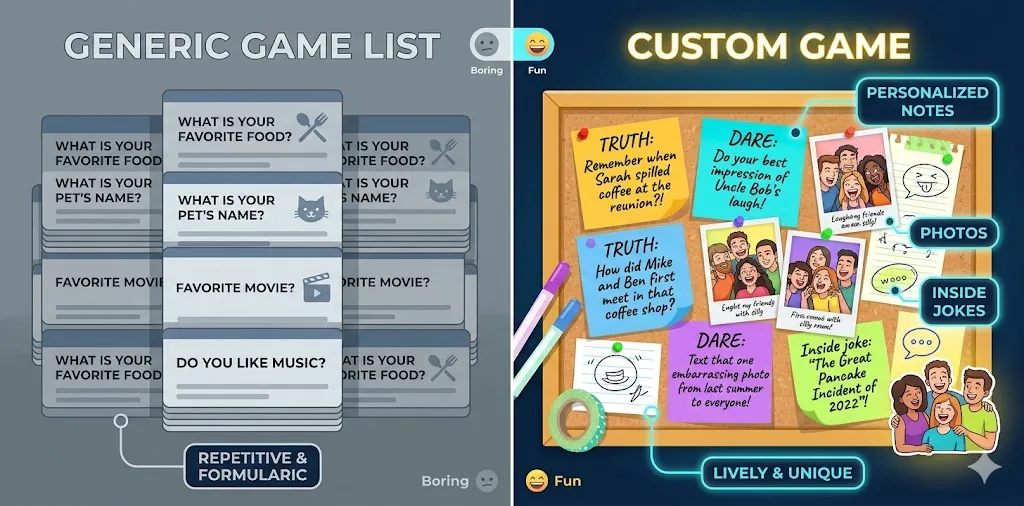
Most people reach for a ready-made list because it feels easier. And for the first few rounds, it is fine. But generic questions have a ceiling. They do not reference anything your group has actually lived through. They do not reflect the tone of your event. They treat a bachelorette party the same as a family reunion. The moment everyone realizes the questions could have been asked by a stranger, the game loses its spark and that moment usually comes faster than you expect.
A custom game does not have that ceiling. When someone gets asked a question that only makes sense because of something that happened between this specific group of people, the whole room leans in. That is the difference you are building toward.
Three Things to Decide Before You Write a Single Question
Before you write anything, you need a clear picture of the game you are making. Skipping this step is why most custom games end up feeling half-finished good questions mixed with filler that did not need to be there.
What Kind of Event Is This?
The tone of your game needs to match the occasion. A game for a cozy family reunion should feel completely different from one for a wild birthday weekend. Getting this wrong means questions that land awkwardly because the room is not in the right headspace for them.
Use this as your reference:
| Event | Tone | Focus |
| Birthday Party | Celebratory, warm | Guest of honor, shared memories |
| Bachelorette / Bachelor | Fun, a little bold | The couple, relationship stories |
| Friends Game Night | Loose, inside-joke heavy | Shared history, personal quirks |
| Family Reunion | Nostalgic, cross-generational | Family stories, funny memories |
| Office / Team Event | Light, strictly safe | Icebreaker, work-safe topics only |
| Sleepover | Silly, personal | School, crushes, funny confessions |
Who Is Actually Playing?
The most important player in your group is not the most outgoing one, it is the most reserved one. Your game needs to work for them too. A question that makes one person deeply uncomfortable will shift the energy for everyone, even if everyone else found it funny.
Take a quick mental inventory before you write. Are these lifelong friends or a mixed group meeting for the first time? Is there a significant age gap? Are there any topics about relationships, family, finances that are genuinely off limits for someone in the room? Build around those answers.
What Do You Want the Game to Do?
Every good custom game has a purpose beyond just filling time. Knowing yours shapes every question you write.
- Break the ice → Light, funny, easy-to-answer truths. Dares that are silly and non-threatening.
- Deepen existing bonds → More personal truths. Questions that invite real stories.
- Create pure laughter → Performance-based dares. Absurd hypotheticals. Questions about embarrassing moments.
- Celebrate someone → Questions and dares that put the guest of honor at the center of every round.
How to Write Custom Truth Questions
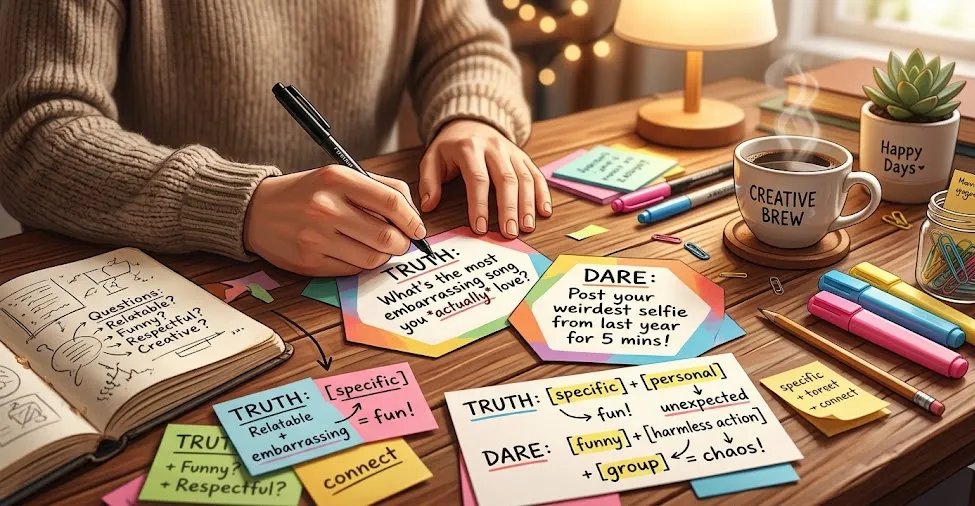
Writing a truth question sounds simple until you try it and end up with something either too vague to get a real answer or too personal to ask in front of a group. The difference between a question that gets a one-word answer and one that starts a ten-minute conversation comes down to a formula.
The Formula for a Great Truth
Specific beats general. The more specific a question is, the more specific the answer will be and specific answers are what create real moments.
Instead of: “What is your biggest fear?” Try: “What is a small, completely irrational fear you have that would surprise people who know you?”
Instead of: “Have you ever lied to get out of something?” Try: “What is the most creative lie you have ever told that someone completely believed?”
Three formulas that work every time:
The First Time Formula: “What was your first impression of [person] when you met them?” Invites a story. Creates a moment for the subject. Works for any group.
The Hypothetical Formula : “If you could trade lives with one person in this room for 24 hours, who would you pick and what would you do first?” Non-threatening. Gets everyone thinking. Always produces a funny or revealing answer.
The Secret Skill Formula: “What is a weird or useless talent you have that nobody in this room knows about?” Light enough for anyone. Almost always produces something unexpected.
What Makes a Bad Truth Question
Avoid questions that can be answered with yes or no. Avoid questions that require knowledge the other players do not have. Avoid questions that are so personal they make the room go quiet in the wrong way.
The test is simple: if the answer could be given in under five seconds without anyone reacting, the question needs to be rewritten.
Custom Truth Examples by Event Type
Custom truth questions change based on the event type, helping the game feel more relevant, fun, and engaging for everyone playing.
Birthday Party:
- What is the most ridiculous thing you and the birthday person have done together that you have never told anyone else?
- Describe the birthday person using only three words but they have to be words nobody else in this room would pick.
- What is a memory of this person that still makes you laugh when you think about it?
- If the birthday person were a film genre, what would they be and why?
- What is the best advice this person has ever given you?
Friends Game Night:
- What is a habit one person in this room has that you find secretly hilarious but have never mentioned?
- What is the most dramatic thing someone in this group has ever done over something completely minor?
- Who in this room would survive longest in a completely mundane disaster like a long power cut and who would crack first?
- What is an opinion someone in this group holds that you genuinely do not understand?
- What is the most memorable thing that has happened in this group that never got talked about properly afterward?
Family Reunion:
- What is the funniest thing you remember happening at a family gathering that younger family members have never heard?
- Which family member are you most like and is that a good thing?
- What is a family tradition you find slightly odd but would never say anything about?
- What is one thing about this family that you think outsiders would find surprising?
- What is the best piece of advice someone in this family gave you that you still use?
Office / Team Event:
- What is a skill you have outside of work that would genuinely surprise your colleagues?
- What is the weirdest thing you have ever done to get through a slow workday?
- What is the most unexpected thing you have learned about this team since joining?
- What is a work habit you have that makes complete sense to you but probably looks strange to others?
- What is one thing about your job that you were completely wrong about before you started?
How to Write Custom Dares
A dare that nobody wants to do and a dare that everyone laughs through are separated by one thing: whether the person doing it gets to be funny rather than just embarrassed. The best custom dares create a performance. They give the player a moment, not a punishment.
The Formula for a Great Dare
Performance beats discomfort. A dare where someone has to do something silly in front of the group produces a shared moment. A dare designed purely to embarrass produces awkwardness and often a skip.
Instead of: “Sing a song.” Try: “Give a full opera-style dramatic performance of the nutrition label on the nearest snack food.” Instead of: “Do 10 push-ups.” Try: “Invent a 30-second workout routine inspired by a household object and lead the entire group in doing it.”
Three formulas that work every time:
The Interaction Dare “Without speaking, using only gestures, convince another player to swap seats with you.” Involves two people. Creates a natural moment. Easy to watch and react to.
The Creative Dare “Using three random objects from this room, create a piece of modern art and give it a pretentious name.” Low physical effort. High entertainment value. Works for any age or ability level.
The Performance Dare “You are now a flight attendant. Perform the full safety demonstration for a flight that is about to land in someone’s living room.” Gives the player a clear role. The absurdity does the work. Almost impossible to do badly.
What Makes a Bad Dare
Avoid dares that require props or setup that are not already available. Avoid anything that takes longer than 60 seconds to explain. Avoid dares that work only if the player is already comfortable if it falls flat when someone is shy, it is not a well-designed dare. The test: could a reserved person complete this dare and still get a laugh? If yes, it is a good dare.
Custom Dare Examples by Event Type
Birthday Party:
- Give the birthday person a completely made-up award and deliver a 30-second acceptance speech on their behalf.
- Describe the birthday person to the group as if you are a wildlife documentary narrator observing them in their natural habitat.
- Recreate the birthday person’s most recognizable facial expression until someone guesses which one it is.
- Make up a movie trailer for a film based on the birthday person’s life give it a title, a genre, and a dramatic tagline.
- Give a toast to the birthday person using only song titles. Minimum five titles.
Friends Game Night:
- Do your best impression of one person in this room, no names, just the impression until someone guesses who it is.
- Narrate the last five minutes of this game as if you are a sports commentator covering the most important match of the year.
- Re-enact the group’s most famous shared memory in under 30 seconds. Play all the parts yourself.
- Make up a group motto and announce it to the room as if it has been the official motto for years.
- Give a motivational speech about an inside joke from this group as if it is the most profound thing that has ever happened.
Family Reunion:
- Do your best impression of how one family member tells a story with no names, let everyone guess.
- Make up a fake family legend and tell it to the group as if it is completely true and well-documented.
- Give a 60-second cooking show demonstration on how to make a dish someone in this family is known for. Be completely professional about it.
- Create a family motto on the spot, present it to the room, and explain why it captures everything about this family.
- Act out a typical family dinner as a one-person show. Play everyone.
Office / Team Event:
- Give a motivational speech about something completely mundane like the importance of a working stapler as if the entire company’s future depends on it.
- Narrate what the person to your left is currently doing as if it is a crucial scene in a workplace drama.
- Pitch your current role to the group as if you are on a startup pitch show. You have 45 seconds. Make it compelling.
- Do a dramatic reading of the most boring email in your inbox right now as if it is the climax of a thriller novel.
- Give a one-minute TED Talk about a skill you have that has nothing to do with your job.
The Personalization Layer (What Makes It Unforgettable)

Good questions and dares make a solid game. But the layer that turns a solid game into something people talk about for months is personalization building references into the game that only this specific group will fully understand.
This is also the easiest part to add once your base questions are written. You are not rewriting anything. You are just making specific details more specific.
Inside Jokes and Shared Memories
Every long-standing group has moments that only they reference. The trip that went sideways. The thing someone said became a running joke. The time something happened that nobody has ever fully explained to anyone outside the group.
These are your best raw materials. A question like “Re-enact the infamous road trip incident from start to finish” or “Describe last summer’s BBQ using only dramatic hand gestures” creates a completely different energy from anything a generic list could produce because it belongs to this group and nobody else.
You do not need many of these. Three or four references woven into a 20-question game are enough to make the whole thing feel personal.
The Guest of Honor Angle
If the game is for a specific person, a birthday, a leaving party, a celebration puts them at the centre of as many questions as possible without making it feel like an interrogation.
The goal is to use the game as a vehicle for the group to share things about that person, not just to ask the person questions about themselves. Questions like “What is the most [name] thing [name] has ever done?” or “If [name] were a movie character, who would they be?” turn the game into a tribute without it feeling like a speech.
Real Example: Custom Game for a 30th Birthday
Say the birthday person calls them Jordan loves cooking and has been on two chaotic group holidays with this friend group.
Generic version:
- Truth: What is your favourite food?
- Dare: Post an old photo on Instagram.
Custom version:
- Truth: “Describe Jordan’s cooking style using only adjectives that also describe their personality.”
- Truth: “What is the most Jordan thing Jordan has ever done on one of our trips the moment you thought, yes, this is exactly who they are?”
- Dare: “Using only ingredients you can find in this room right now, describe a dish Jordan would invent and give it a name they would genuinely use.”
- Dare: “Re-enact Jordan’s reaction when [reference to a real shared trip moment]. The group votes on accuracy.”
The difference is not the format. It is the specificity. Every one of those questions can only be answered by people who know Jordan. That is what makes them land.
How to Present Your Custom Game
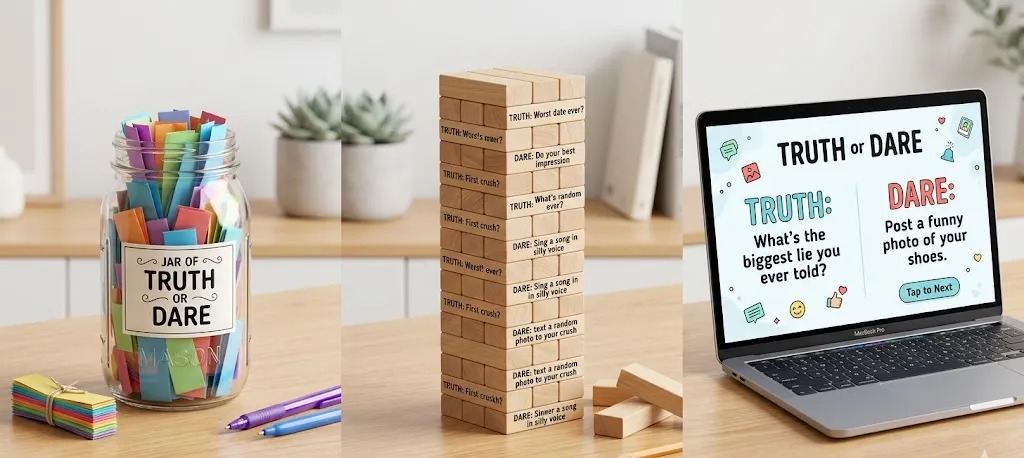
The questions are written. Now you need a way to deliver them during the game. How you present the game affects how it feels to play and a poor delivery method can slow down a great set of questions.
The Jar Method
Write each truth on one colour of paper and each dare on another. Fold them and drop them into two separate jars. Players draw from whichever jar matches their choice.
This is the most flexible option. You can add or remove questions between rounds, keep the jars topped up before the game starts, and swap questions out if something is not landing. It is also visually satisfying there is something about drawing a folded piece of paper that builds anticipation better than reading from a screen.
Best for: home parties, family gatherings, intimate groups.
The Jenga Version
Buy a cheap Jenga set and write one truth or dare on the flat side of each block using a permanent marker. When a player pulls a block, they complete whatever is written on it.
This version adds a physical element that keeps everyone engaged even when it is not their turn. The tension of pulling a block and potentially toppling the tower creates energy that a jar cannot. The downside is permanence: once written, the questions are fixed, so build your set carefully.
Best for: parties where you want a prop that doubles as a centrepiece, groups who enjoy physical games alongside conversation.
The Digital Slideshow
Build a simple presentation one truth or dare per slide. Use a shared screen, a TV, or a laptop that everyone can see. This works particularly well for larger groups, virtual gatherings, or events where you want to include photos, GIFs, or visual references alongside the questions. A slide that shows a photo of the group alongside a question about a shared memory lands differently than just reading the question aloud.
Best for: virtual parties, large groups, events where a screen is already part of the setup.
Mistakes to Avoid When Customizing
Most custom games fail not because the ideas are bad, but because small planning mistakes make the game awkward or unbalanced.
- Writing questions only the host finds funny: Inside jokes should work for everyone in the group. If only a few people understand the reference, the rest feel left out and the moment loses its energy.
- Forgetting quieter players: Many questions unintentionally favor loud and confident players. Include simple, low-pressure questions so quieter players can also participate comfortably.
- Making every dare a performance: Too many acting or performance-based dares become tiring. Mix different types like quick actions, verbal dares, and small group tasks to keep balance.
- Not testing questions before the game: Always review your list in advance. Check if any question feels too personal, confusing, or unsuitable for someone in the group.
- Going too long with the game: Too many questions make the game drag. Keep it around 15–20 well-chosen prompts so the energy stays high and the game ends on a fun note.
FAQs
How many questions do I need for a custom game?
For 4 to 8 players, 15 to 20 total questions is ideal, split evenly between truths and dares. This allows everyone to get 2–3 turns without slowing the game down.
How far in advance should I create the questions?
A day or two before the game is best. It gives you time to be creative but also revise and remove anything unclear or unsuitable.
What if I run out of custom questions mid-game?
Keep a backup list of 5–10 simple questions ready. You can also let players suggest ideas, but quickly review them before using.
Can I mix custom and generic questions?
Yes. Custom questions create personality and memorable moments, while generic ones help maintain flow and fill gaps in the game.
What is the best format for a large group?
A digital slideshow works best for 12+ players. It keeps everyone on the same page, maintains pace, and avoids confusion.
How do I handle a question that does not land?
Don’t overthink it just move on quickly. Say “next one” and continue so the energy of the game stays intact.