How to Host a House Party That People Actually Talk About
You cleaned the apartment. You built the playlist. You spent hours on the food. And still the night felt kind of off. Guests clustered in corners. Conversations were polite but forgettable. By 10pm, people were slipping out with a quick hug and a “this was so fun” that did not quite convince anyone.
Here is the truth: most parties fail not because of the food or the music or the décor. They fail because no one thought about why the party existed in the first place and what would make the people in the room actually connect. This guide covers both. Not just the logistics, but the things that separate a party people forget from one they talk about for weeks.
What Makes a House Party Actually Fun?
If you want the short version before we dive in:
- Know why you are hosting before you plan anything else
- Invite people who will genuinely enjoy each other not just everyone you know
- Give guests something to do other than stand around with a drink
- Be present not running around managing everything
- End the night deliberately so it closes on a high note instead of a slow fizzle
Everything below expands on these five things.
Know Your “Why” Before You Plan Anything

Before the guest list, before the theme, before the food ask yourself one question: Why am I hosting this? Not “because it’s someone’s birthday” or “because it’s been a while.” Go deeper. What do you actually want people to walk away feeling?
- Is it to introduce two groups of friends who would love each other?
- Is it to celebrate something that does not get celebrated enough?
- Is it to create a moment of warmth after a hard stretch?
- Is it just to have an excuse to bring people together who make you laugh?
Every decision you make after this who you invite, what you serve, what activities you plan answer is “I’m not sure,” keep asking why until you get to something real. That moment of clarity will shape the entire night.
Build Your Guest List Like a Curator, Not a Contact Exporter
The biggest mistake hosts make is inviting everyone they know to everything they host. That is how you end up with 30 people who have nothing to say to each other. Think about who belongs in the same room at the same time.
Who would genuinely enjoy each other’s company? Who would you love to introduce to each other? Who fits the specific energy of this particular night?
A few things to consider:
- Match the group to the occasion. A cozy dinner works for six people who can really talk. A backyard cookout works for a wider mix.
- Invite someone unexpected. One person you met recently, one contact you have been meaning to know better this often produces the most interesting conversations.
- Keep the room manageable. Smaller groups create more real connection than large ones. People do not need to meet everyone they need to actually meet someone.
You do not have to invite every person to every event. Different gatherings are for different people. That is not exclusion that is good hosting.
Write an Invitation That Makes People Say Yes Immediately
Most invitations are just logistics: date, time, location, RSVP. That is enough to inform people. It is not enough to make them excited. A great invitation tells a small story. It gives people a reason to show up beyond obligation. It sets the tone before anyone walks through the door. Instead of: “Come over Saturday at 7 bring a dish!”
Try something like: “I want to get a group of people together who I have been meaning to see properly not just for five minutes at someone else’s thing. Good food, easy evening, nowhere to be the next morning. Come if that sounds right.”
The specificity matters. The warmth matters. If you want people to feel something at your party, start by making them feel something when they read the invite.
Send it far enough ahead two weeks minimum for casual parties, three to four weeks for something bigger. And make RSVPs easy. A free tool like Partiful sends text reminders, shows who is coming, and removes all the back-and-forth.
How Much Does a House Party Actually Cost?
You don’t need a big budget to host something memorable. Here’s a realistic breakdown for 10–15 guests:
- Budget ($50–75): Homemade punch, chips and dips, playlist on Spotify free tier, string lights you already own.
- Mid-range ($100–150): One signature cocktail with quality ingredients, a cheese board, a couple of games with small prizes, disposable but nice-looking tableware.
- Elevated ($200–300): Catered finger foods or a few premium takeout trays, a stocked self-serve bar, professional string lighting or candles, printed favors for guests to take home.
The truth: guests remember how they felt, not how much you spent. A $50 party with genuine warmth beats a $300 party that feels stiff.
The Space Does Half the Work
You do not need a big space to throw a good party. In fact, bigger is often worse. When people drift through too much open space, the energy disperses. Conversations never quite get going because the room feels too thin. One of the most reliable things a host can do is create smaller pockets within the space a drinks station in one corner, seating arranged to face each other, a food table that pulls people together rather than spreading them across a room.
If you are hosting indoors, here is what actually works:
- Rearrange the furniture. Pull seating into clusters that face each other. Remove anything that blocks natural flow.
- Use lighting to set the mood. Dim the overheads. Add floor lamps, string lights, or candles. Bright fluorescent light kills the relaxed feeling you are trying to create.
- Keep the kitchen accessible. Guests almost always drift toward the kitchen not because the food is there, but because it is a contained, natural gathering point. Lean into it.
- Set up more than one drinks area. Two self-serve drink stations in different spots keeps guests moving and mixing rather than clustering in one place.
The goal is a space that feels alive and full not empty and echoey.
Food That Looks as Good as It Tastes

The food does not have to be elaborate. It has to be right. A few principles that work every time:
- Make things people can eat while standing. Finger foods, small bites, things that do not require a knife and fork. This keeps people mobile and keeps conversations uninterrupted.
- Stick to what you know. A house party is not the night to test a new recipe. Make the thing you have made before, the one you know works. Save experimentation for a Tuesday when the stakes are lower.
- Present it with care. Height creates visual interest. Use a few cake stands, turned-over bowls, or wooden boards at different levels. Label things clearly guests appreciate knowing what they are eating, especially if they have dietary restrictions.
- Always include a dessert. Something sweet signals celebration and gives the night a natural peak. It does not have to be complicated a plate of good cookies or a bowl of chocolate bars works as well as anything elaborate.
- Ask guests to bring something specific. “Bring a snack to share” is vague. “Bring your favourite dip or a bottle of something you love” gives people a clear role and takes pressure off you.
Drinks Without the Drama
A full bar and a professional bartender sounds impressive. It also requires someone managing it all night, running out of specific things, and guests waiting in line.
Simpler approaches that actually work better:
- Make one signature drink in bulk. A punch, a sangria, a pre-mixed cocktail something you prepare before guests arrive and set out in a large vessel with a ladle. No measuring, no mixing to order, no fuss.
- Set up a self-serve area. Wine bottles on a table, a cooler with drinks on ice, a clear space with glasses nearby. Guests can help themselves without finding you.
- Always have non-alcoholic options. Sparkling water, good juice, a non-alcoholic alternative. This is not optional make sure there is something good for people who are not drinking.
- The bathtub or kitchen sink trick. Fill it with ice and stick wine bottles and cans in. It frees up fridge space, keeps things cold, and people love it.
The best drinks setup at a party is the one you do not have to think about once guests arrive.
Activities That Actually Get People Talking
Left to their own devices, most guests will find the people they already know and stay there. That is comfortable but it is not memorable. Give people something to do that naturally introduces them to someone new.
Games that work for mixed groups:
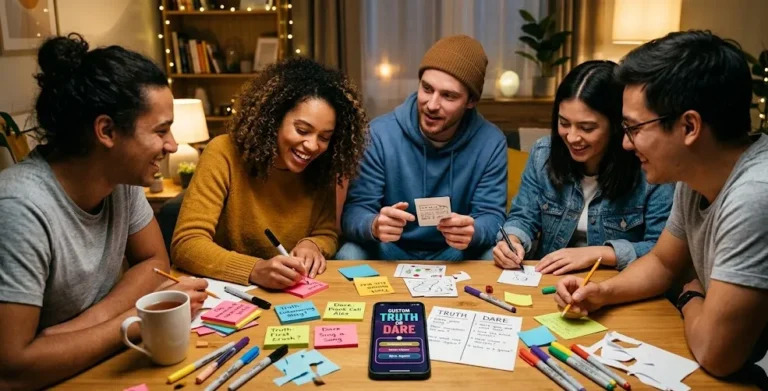
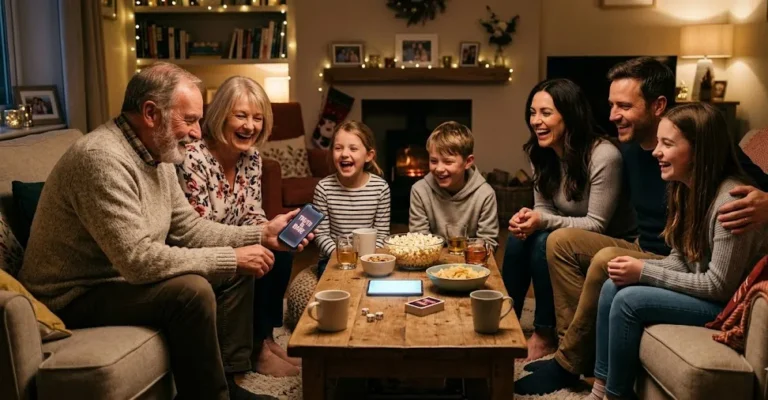
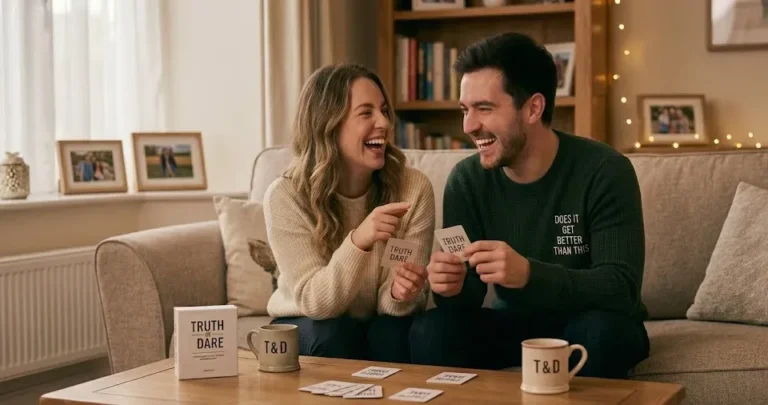
- Truth or Dare a classic for a reason. Works for any age group with the right questions.
- Most Likely To: everyone votes, everyone laughs, and you learn things about your friends that surprise you
- Two Truths and a Lie: simple, quick, works with any group size
- Trivia in teams: split people into mixed groups so old friends are separated and new connections form
Activities beyond games:
- A themed photo setup with a few props guests take photos throughout the night and it gives everyone something to do with their hands
- A “bring your favourite something” element your favourite bottle, your favourite song to add to the playlist, your favourite snack this gives people an easy conversation starter
- A simple question on the table or near the food: “What is one thing you are looking forward to this year?” people answer it naturally while getting food and it opens real conversations
The rule of thumb: at least one thing for guests to do that is not just standing and chatting.
The First Five Minutes Make or Break the Night
Studies on memory show that people disproportionately remember the beginning and the end of an experience. The middle can take care of itself but how you open matters more than most hosts realise.
When guests arrive:
- Greet them at the door. Not from across the room. At the door, with your full attention.
- Hand them a drink immediately. Something to hold removes the awkwardness of the first few minutes.
- Introduce them to someone right away. Even a quick “You have to meet Sam you both [shared thing]” gives them a landing place before you need to go greet the next person.
- Make a brief welcome moment. It does not have to be a speech. Light a candle, raise a glass, say one sentence about why you are glad everyone is here. Something to officially start the evening rather than letting it drift into being.
The first impression your guests get of the night the warmth at the door, the drink in hand, the feeling of being placed sets the emotional temperature for everything that follows.
Hosting Rules That Make Guests Feel Seen
The best hosts do not disappear into the background. They actively manage the room not in a controlling way, but in a way that makes sure everyone is having a good time.
A few things to watch for:
- Introduce guests who haven’t met. Be specific. “You both moved here from somewhere else in the last two years” lands better than “I think you’ll get along.”
- Notice who is standing alone. Bring someone over to them. Give them an easy in. Do not leave anyone stranded.
- Redirect conversations that are going too long between two people who already know each other. Gently bring in someone new, or shift the group.
- Set one playful rule before the night starts. A secret society in San Francisco once told guests they could not pour their own drink they had to find someone else to pour it for them. It sounds strange. It worked brilliantly. The rule gave people a natural reason to interact with strangers. You can invent your own version.
Your guests want to feel like the evening has some shape to it not a lawless free-for-all where they drift until it feels late enough to leave.
What to Do When Things Go Off-Script
Something will not go according to plan. The food takes longer than expected. A guest brings someone unexpected. The activity you planned falls flat. Someone spills something significant. The host’s job in these moments is simple: do not panic visibly.
Your guests take their emotional cues from you. If you are unfazed by something going sideways, they will be too. If you treat a small problem like a catastrophe, it becomes one.
A few practical things that help:
- Prepare your fallback menu item. One thing that requires no cooking and can appear instantly good cheese and crackers, olives, bread, whatever for if something does not work out.
- Have a backup game or activity. One you can pull out in under a minute if the energy drops.
- Keep extra drinks chilled. Running out of drinks is the one thing guests genuinely notice.
- Accept that imperfection is part of it. The party people remember is not the one that was flawless. It is the one where something went slightly wrong and everyone laughed about it.
Flexibility is a hosting skill, not a fallback.
The Day-Of Checklist

Most party stress happens in the hour before guests arrive. Here is a simple checklist to make that hour calmer:
Two hours before:
- Food is prepped or in progress nothing requires attention during the party
- Drinks set up and chilled
- Music playlist ready and playing
- Space arranged furniture moved, surfaces clear
- Bathroom clean with extra hand towels and soap
One hour before:
- Lighting adjusted overheads dimmed, candles or lamps on
- Self-serve drink area set up
- Food table laid out with labels
- Activity or game materials ready
- One thing you personally need your drink, your shoes, five minutes to yourself
When guests start arriving:
- Door open, you are near it
- First drink ready to hand over immediately
- First introduction planned for the first arriving guest
If this list is done, you can enjoy the party. That is the point.
How to End the Night on a High Note
Most parties do not end they fade. Guests start glancing at their phones. Someone makes a move for the door. Others follow with that slightly relieved energy of “I think this is ending.” You can do better than that. Signal the end deliberately:
- Gather everyone for one last drink or coffee together
- Share a highlight from the evening a funny moment, something you noticed, a story someone told
- Walk each guest to the door individually as they leave
And give them something small to take with them. It does not have to be expensive. A bar of chocolate, a small bag of something homemade, a printed recipe from what you served. Priya Parker, who studies what makes gatherings meaningful, calls these “tiny little acts” that add up to something bigger. What they say is: you matter, and I am glad you were here. That is how a party ends well.
FAQs
How far in advance should I plan a house party?
For a casual gathering of 10 to 15 people, two to three weeks is usually enough. For larger events, planning four to six weeks ahead gives guests plenty of notice.
How many people is ideal for a house party?
The ideal number depends on your space and the atmosphere you want to create. Smaller groups encourage deeper conversations, while larger groups bring more energy and variety.
Do I need a theme?
No, a theme is optional. While a good theme can add excitement and help guests connect, great hosting and a welcoming atmosphere matter far more.
What if I have a small space?
Small spaces can create a cozy and engaging environment. Smart furniture arrangements and comfortable gathering areas often lead to better conversations and stronger connections.
How do I handle guests who do not know each other?
Make introductions based on shared interests and provide activities that encourage interaction. A few thoughtful connections can quickly break the ice.
What is the one thing I should never skip?
Greeting guests at the door. A warm welcome sets the tone for the entire event and helps everyone feel comfortable from the moment they arrive.
Final Thoughts
The best house parties are not the ones with the most impressive food or the most elaborate theme. They are the ones where people left feeling like they genuinely connected with someone where the night had shape, warmth, and a reason to exist beyond filling a Saturday.
You do not need a big budget or a perfect apartment or years of experience. You need a clear intention, a guest list that makes sense, and enough presence as a host to make people feel seen while they are in your space. The rest is details. And the details, it turns out, are a lot more forgiving than you think.