
History of Truth or Dare The Complete Story Nobody Has Fully Told
Most games have a creator. Truth or Dare has none. No one invented it. No one decided it should exist. It just kept reappearing in ancient Greece, in medieval French streets, in Victorian drawing rooms, at 1950s sleepovers, in a Madonna documentary, and tonight on someone’s phone.
Every generation discovered it independently because it solves a problem that never goes away: how do you get people to be genuinely honest with each other in a way that feels fun instead of threatening? This article covers the full story where the game came from, how it changed, why it survived, and how to play it well.
Timeline at a Glance
| Era | What Happened |
| Ancient Greece (c. 400 BC) | Basilinda king commands truth or action, forfeit for refusal |
| 1345 France | Roi qui ne ment The King Who Does Not Lie, first documented version |
| 1677 England | Guy Miege writes first official definition of Questions and Commands |
| 1712 | Christmas game version recorded with exact forfeit rules |
| 1788 | James Gillray illustrates the game as a structured evening amusement |
| 1868 | Appears without explanation in Little Women already culturally familiar |
| Early 1900s | Name shifts from “Questions and Commands” to “Truth or Dare” |
| 1950s–60s | Becomes a teen sleepover and summer camp staple |
| 1991 | Madonna names her documentary Truth or Dare global name recognition |
| 2018 | Horror film of the same name brings it to a new generation |
| 2020s | Apps, online generators, and video call versions reach millions worldwide |
Where It All Began
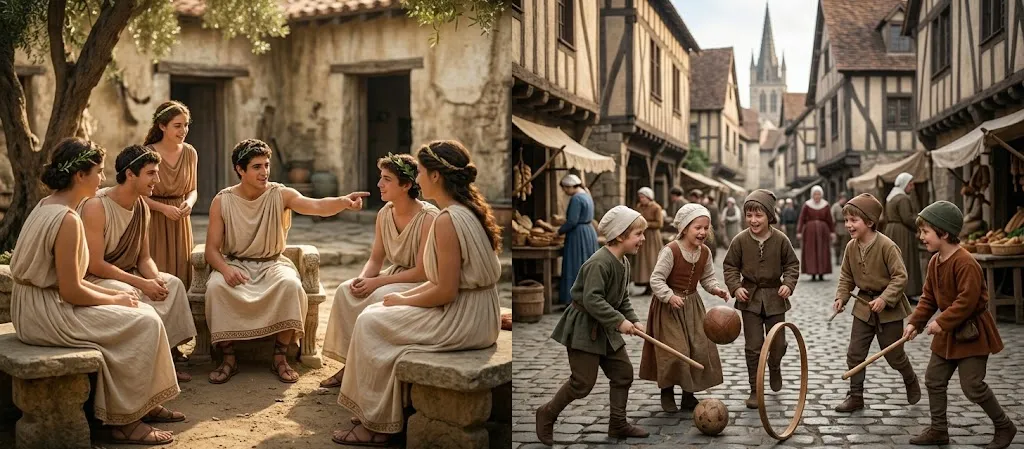
Truth or Dare didn’t begin with a single inventor. Its origins can be traced to ancient Greece and medieval France, where early games of questions, commands, and forfeits laid the foundation for the modern classic.
The Ancient Greek King Game
The oldest known ancestor of Truth or Dare comes from ancient Greece. It was called Basilinda roughly translated as the King Game. One player was chosen as king by lot. That king could command anyone in the group to do something perform a task or answer a question honestly in front of everyone. Refuse, and you paid a forfeit decided by the group.
The Greek philosopher Julius Pollux described it as a game where “a king, elected by lot, commanded his comrades what they should perform.”
Both halves of the modern game were already there the dare (perform an action) and the truth (answer honestly in public). The core structure has not changed in over two thousand years.
The Romans ran a similar version during Saturnalia, their midwinter festival where social hierarchies were temporarily suspended. A temporary king was chosen by lot and could command anyone present including demanding honest answers to personal questions in front of the assembled group.
A French Street Game From 1345
Most people assume England invented this game. That assumption is wrong. In 1345 France, children were already playing a street game called Roi qui ne ment The King Who Does Not Lie. The king was required to answer every question put to them honestly, in front of everyone, with no escape except a penalty forfeit.
This is the truth half of Truth or Dare, formalised and documented in French streets more than 150 years before Shakespeare was born. Importantly, these were not aristocratic games. They were played in public squares and markets by ordinary children. This tells us something that matters: from its earliest documented form, this game was a tool for social connection among people who did not necessarily know each other well. That function has never changed.
The First Time Anyone Wrote It Down (1677)
The first formal written definition of the game appears in 1677, in a French-English dictionary compiled by linguist Guy Miege.
He called it Questions and Commands and defined it as:
“A game where the person presiding gives each member of the company a certain number of questions to answer and commands to obey, for whatever reason they deem appropriate.”
The fact that it appeared in a bilingual dictionary not a game manual tells us the game was already well-established enough on both sides of the English Channel to be treated as a cultural reference point, not a novelty.
By 1712, a Christmas version was formally recorded:
“A Christmas game, in which the commander bids their subjects to answer a question. If the subject refuses or fails to satisfy the commander, they must pay a forfeit or have their face smutted.”
“Smutted” meant having your face marked with soot a playful humiliation that served the same purpose as a modern dare penalty. The mechanism is identical.
The 1788 Illustration That Proves It Was Everywhere
In 1788, the artist James Gillray created an illustrated publication titled Questions and Commands: A Sunday Evening’s Amusement.It depicted well-dressed Georgian men and women playing the game at a social gathering issuing and receiving commands, laughing at the results. By this point, the game was established enough to warrant its own illustrated guide. It was not a novelty. It was part of ordinary social life.
How the Game Evolved
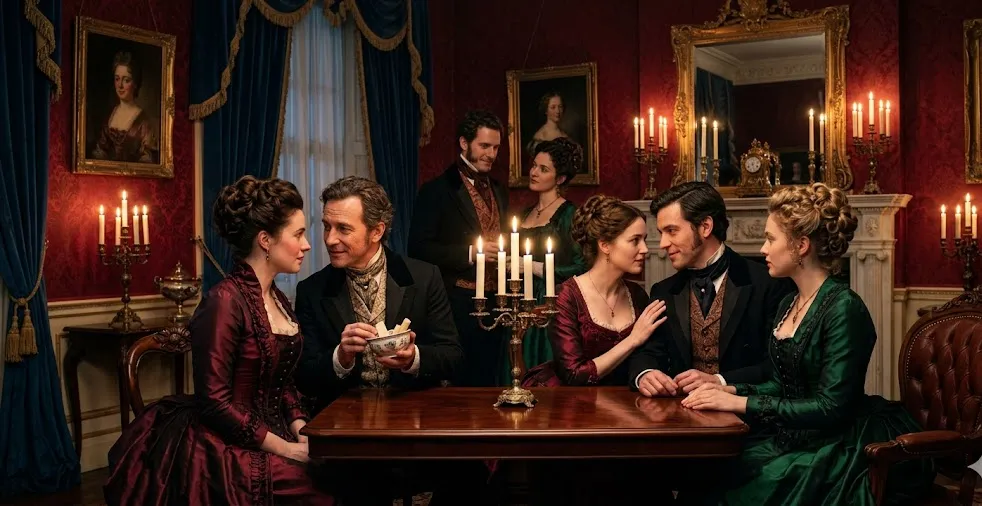
As Truth or Dare spread across different cultures and generations, its rules, name, and purpose gradually evolved. What began as simple question-and-command games eventually transformed into the familiar choice between revealing a truth or completing a dare.
Why the Victorians Loved It (The Flirting Angle)
The Victorian era gave this game one of its most interesting social functions. Victorian society operated under rigid rules especially around gender. Men and women were rarely left alone together. Asking a personal question in ordinary conversation was considered improper. Courtship was formal, chaperoned, and carefully managed by families.
Parlour games like Questions and Commands provided a legitimate exception. Under the cover of a game, a young man could ask a young woman something genuinely personal and everyone present accepted it because everyone was playing. The group’s collective agreement created a temporary space where normal rules were suspended.
One of the earliest documented dares from this era recorded in a 1685 publication on courtship involved a woman being commanded to place her corset busk into a man’s coat pocket. Considered bold for the era, it illustrates how the game was actively used for flirtation in controlled social settings.
Victorian versions were considerably more restrained than modern play. The goal was warmth and mild romance not shocking revelations. But the mechanism was the same: a safe frame for mild transgression.
It Appeared in a Classic Novel Without Any Explanation (1868)
In Louisa May Alcott’s Little Women (1868), the characters play a version of Questions and Commands at a party at Camp Laurence. Alcott does not explain the rules. She does not name the game or describe how it works.
She did not need to. Her readers already knew. That absence of explanation is more significant than any description would have been. By 1868, the game was so embedded in everyday social life that one of the most widely read novelists of the century assumed her entire audience would recognise it instantly.
How “Questions and Commands” Became “Truth or Dare”
This is the part of the history that almost no one covers. At some point in the early 20th century the exact date is not documented the procedural name Questions and Commands was quietly replaced by a cleaner, more dramatic phrase: Truth or Dare.
Three words. A direct binary. No explanation of presiding officers or numbers of commands. Just a choice stated plainly. The new name captured the essential tension of the game better than anything that came before it. You either tell the truth, or you do the dare. Everything else is detail.
This renaming coincided with the game’s shift from adult parlour entertainment to specifically a teenage ritual spreading through summer camps, sleepovers, and youth culture in America and Britain during the first half of the 20th century.
The Post-War Teen Takeover (1950s)

After the Second World War, Truth or Dare became a genuine cultural staple not through any promotion, but through sheer peer transmission. Teen magazines in the United States began printing suggested question lists and dare ideas. Summer camp counsellors included it in organised activities. Young adult fiction used it as a plot device.
By the 1950s, Truth or Dare was something you already knew about before you ever played it because it was so deeply embedded in the social language of adolescence that it arrived through cultural osmosis rather than discovery.
Madonna Changed Everything (1991)
No single event did more for the game’s global visibility than a documentary film released in May 1991. Madonna titled it Truth or Dare known internationally as In Bed With Madonna. Directed by Alek Keshishian, it documented her 1990 Blond Ambition World Tour and screened at the Cannes Film Festival before global release.
It became the highest-grossing documentary film in history at that time, earning approximately $29 million worldwide a record it held until 2002. The title was not chosen casually. The film was built around the same tension the game has always contained the choice between honest self-disclosure and bold performance. Madonna used both throughout: revealing genuinely personal moments while staging and performing others.
In countries where the game was not already widely known, the film title functioned as an introduction. After 1991, the phrase needed no translation and no context anywhere in the world.
The 2018 horror film of the same name starring Lucy Hale and Tyler Posey, directed by Jeff Wadlow used the dare-or-consequence format as the mechanism for a supernatural thriller, introducing the game’s structure to an entirely new generation through a very different lens.
From Apps to Video Calls: The Digital Chapter

The internet did to Truth or Dare what it did to almost every social game: it removed the requirement for physical presence. Early 2000s websites offered simple random question generators. Smartphone apps added categories, spice levels, and multiplayer turn tracking. During 2020 and 2021, with in-person gatherings restricted worldwide, couples and friend groups turned to video call versions of the game to maintain genuine connection across distance.
Every time a social context changed throughout history stricter social rules, new social spaces, global restrictions on gathering the game adapted. It has always found a way to fit the conditions people are actually living in.
Why It Has Never Disappeared
Truth or Dare has survived for centuries because it fulfills a timeless human need: creating honest, memorable connections in a fun and low-pressure way. No matter how society changes, people continue to enjoy games that encourage openness, curiosity, and shared experiences.
The Psychology Behind a 2,000-Year-Old Game
The most striking thing about this history is not that Truth or Dare survived for two thousand years. It is that it survived without anyone deciding to keep it alive. No institution promoted it. No company owned it. No government protected it. It persisted because each generation found it genuinely useful and passed it on to the next.
The reason is psychological. In ordinary social life, most people manage their self-presentation constantly giving polished answers, avoiding personal disclosure, not asking questions that might seem intrusive.
Truth or Dare creates what sociologists call a magic circle a bounded space with its own rules where normal social expectations are temporarily suspended by group agreement. Within this space, honesty and daring are not just permitted but required. The risk feels manageable because everyone signed up for it together.
You are not being vulnerable. You are playing the game. This psychological function is why ancient Greeks, medieval French children, Victorian adults, and modern teenagers all independently arrived at the same basic format. It was not borrowed or inherited. It was rediscovered because it addresses something fundamental about human social life that has not changed and is not likely to.
How to Actually Play It Well
This section is missing from most history articles but it is what many readers are also looking for.
Before You Start: Set the Tone
The most common mistake in Truth or Dare is starting without agreeing on the vibe first. A quick 30-second conversation before the game saves a lot of awkwardness during it.
Decide together:
- Light or deep? Funny and silly, or more personal and honest?
- What is off-limits? Topics, types of dares, or anything that makes someone uncomfortable agree upfront, not mid-game.
- Skip rule? Anyone can pass on any question or dare without explanation. This keeps the game enjoyable for everyone.
- Forfeit or no forfeit? If someone skips, is there a playful penalty? Make it fun, not pressuring.
How to Ask a Better Truth
Bad truth questions produce one-word answers and kill the energy. Good truth questions open a door.
What makes a truth question work:
- Be specific “What’s your most embarrassing childhood memory?” gets a better answer than “What’s embarrassing about you?”
- Build a ladder start light, move deeper as the group gets comfortable
- Avoid yes/no questions that start with “Have you ever…” often end there; questions that start with “What/When/How” keep going
- Match the group a question that works with close friends might not land with people who just met
Examples of questions that work:
- “What’s something you believed until embarrassingly recently?”
- “What’s one thing you’ve never told anyone in this room?”
- “When did you last change your mind about something important?”
How to Give a Better Dare
A dare that makes someone genuinely uncomfortable is not a good dare it is a bad host decision. A dare that makes everyone laugh, including the person doing it, is the goal.
What makes a dare work:
- Creative over risky the best dares require imagination, not bravery
- Know your audience what is funny to one group is mortifying to another
- Safe for everyone present nothing physical that could cause harm, nothing that requires posting online without consent, nothing involving people outside the room
- Short and clear the dare should be explainable in one sentence
Examples of dares that always work:
- Sketch a portrait of someone in the room in 60 seconds
- Do an impression of the person to your left until someone guesses who it is
- Send a compliment to the 10th person in your contacts list right now
- Speak only in questions for the next two rounds
Playing Over Text or Video Call
Truth or Dare works across distance with a few small adjustments.
For text play:
- Truths work exactly the same send the question, get the answer
- Dares should be things the other person can do solo and document: take a photo of something in their room, send a voice note, write a three-line poem and send it
- Response dares work well: “Send me the most recent photo on your camera roll” or “Text the funniest GIF you can find to the 5th person in your contacts”
For video calls:
- Physical dares are fine the whole group can watch via camera
- Reaction dares are especially good on video: “Do your best impression of me” lands better when everyone can see it in real time
- Time-limited dares keep the energy up “You have 45 seconds to find something in your room that starts with the letter I”
Safety and Consent: The One Rule That Matters Most
This part is short because it should be obvious but it is worth stating clearly. No one should feel pressured to answer any question or complete any dare. The skip rule is not a weakness in the game. It is what makes the game work.
When people know they can opt out without consequence, they are more likely to opt in which is where all the good moments actually come from. Anyone who pressures another player into doing something they have declined is not playing the game well. They are misunderstanding what makes it fun.
FAQs
Who invented Truth or Dare?
No single person invented it. The game evolved independently across ancient Greece, medieval France, and 16th-century England through a shared tradition of command-and-forfeit social games. It has no inventor and no patent.
What was Truth or Dare originally called?
The most widely documented early name is Questions and Commands, recorded in England from at least 1677. In 14th-century France, a closely related game was called Roi qui ne ment The King Who Does Not Lie.
When did the name “Truth or Dare” first appear?
The name became common during the early 20th century as the game simplified and spread through teen culture. The precise date of the name change is not documented in any known historical source.
Is Truth or Dare mentioned in any classic literature?
Yes. Louisa May Alcott included a version of the game in Little Women (1868) without any explanation suggesting it was already so culturally familiar that her readers needed no introduction to it.
How did Madonna make the game famous worldwide?
Her 1991 documentary film Truth or Dare became the highest-grossing documentary in history at the time, earning $29 million globally. It introduced the game’s name to audiences in countries where the game was not previously well known.
Can Truth or Dare be played online or over text?
Yes—and it has been since the early 2000s. Text versions use questions as truths and solo-completion dares. Video call versions allow physical dares to be performed and watched in real time. Long-distance couples and friend groups have played it this way for years.
What age is Truth or Dare appropriate for?
The game adapts to any age depending on the questions and dares chosen. With age-appropriate content, it works well for children, teenagers, and adults. The content determines the suitability, not the game format itself.
Is Truth or Dare safe to play?
Yes, when played with a clear skip rule and mutual respect. The core safety principle is simple: no one should feel pressured to answer any question or complete any dare they are not comfortable with.
Final Thoughts
Truth or Dare has been around for over two thousand years for one reason: it works. It works because it gives people a structured way to be honest with each other and honest moments, even small ones, are what people actually remember from a night together.
The questions change. The dares change. The platforms change. The essential thing someone chooses, something real happens, the group shares a moment has not changed since the first Greek king issued his first command. Play it well tonight.